Can't Add Gmail Account To Outlook For Mac
Outlook for Office 365 Outlook for Office 365 for Mac Outlook 2019 Outlook 2016 Office for business Office 365 Admin Outlook 2013 Office 365 Small Business Office 365 Small Business Admin Outlook Web App for Office 365 Outlook Web App for Office 365 Small Business Outlook 2010 Outlook 2007 Outlook 2016 for Mac Office 365 operated by 21Vianet - Small Business Admin Office 365 operated by 21Vianet - Admin Outlook 2019 for Mac Outlook Web App There are many different types of email accounts you can add to Outlook, including Office 365, Gmail, Yahoo, iCloud, and Exchange accounts. Some third-party email providers, like Gmail, Yahoo, and iCloud, require you to change some settings on their websites before you can add these accounts to Outlook. Enter your name, email address, and password, and click Next. If prompted, enter your password again, then select OK Finish to start using your email account in Outlook. If you need instructions for adding an email account using advanced settings, see. To update your email settings such as incoming and outgoing server names, see. Outlook won't accept my password If Outlook won’t accept your password and you know you’re using the password for your email account, you might have an email account that requires additional security.
Gmail, Yahoo, iCloud, and AOL accounts all use two-factor authentication to help verify that you’re the person trying to access your email account. To add your email account to Outlook, you’ll need an app password. This is a different password than your regular email account password. The steps to obtain an app password are different for each email provider. Select your provider in the drop-down for instructions. Gmail does allow you to add your account to Outlook without setting up two-factor authentication and using an app password, but you must turn on a setting that allows 'less secure apps' to connect to your account.
We do not recommend this setting. We recommend turning on two-factor authentication and using an app password. To turn on two-factor authentication and get an app password, use the following steps. Go to from your browser, then select the Google apps icon in the upper right corner of the screen. Select My Account. Under Sign-in & security, select Signing in to Google.
Under Password & sign-in method, if 2-Step Verification is OFF, click the next to OFF. Otherwise, skip to step 4. On the first screen, click CONTINUE. If prompted, enter your Gmail password and then click NEXT.

Enter your phone number and select whether you want to receive your verification codes by text message or a phone call. Then click NEXT. Enter the code you received and click NEXT. Click TURN ON to finish setting up 2-step verification. Return to the previous screen by clicking the left arrow at the top of the screen next to 2-Step Verification. Under Password & sign-in method, select App passwords. Enter your Google password and then select Sign in.
At the bottom of the next screen, select Mail and Windows Computer from the drop-down lists, then select Generate. Google will display an app password for you.
Copy this password (without the spaces) and enter this password when Outlook prompts you for a password. Go to the website from your browser and select the settings icon in the upper right corner of the screen.
Select Account info Account security. You may need to sign in again. If Two-step verification isn't turned on, you'll need to do that before you continue.
Then select Manage app passwords. Select Outlook Desktop from the drop-down list, and then select Generate.
Yahoo will display an app password for you. Copy this password (without the spaces) and enter this password when Outlook prompts you for a password. Go to the website from your browser and enter your Apple ID and password. If you've already turned on two-factor authentication, you'll receive a code on one of your devices.
Enter this code to continue. Otherwise, turn on two-factor authentication. In the Security section, under APP-SPECIFIC PASSWORDS, select Generate Password.
Enter a name for your password, such as Outlook, and select Create. Apple will display an app password for you. Copy this password (without the spaces) and enter this password when Outlook prompts you for a password. Note: AOL and Verizon customers who need to update their account settings after AOL's recent change to their server settings should see the section. When checking your encryption settings, make sure they're set to SSL, SSL/TLS, or Auto and not TLS only.
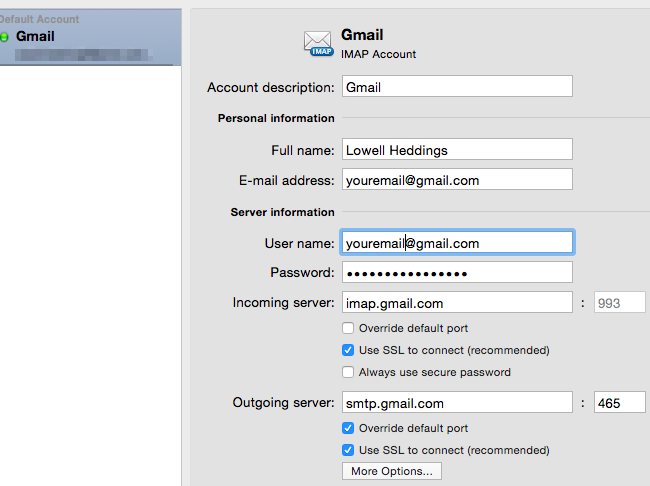
Add a new account quickly Most email accounts, including Office 365, Exchange server accounts, Outlook.com, Hotmail.com, Live.com and Google accounts can be set up in a few quick steps. Select Outlook Preferences Account. Click the plus ( +) sign New Account. Type your email address Continue. Type your password Add Account. (Your screen might look different from this one depending on the account you're adding.).
If adding a Yahoo, or other IMAP or POP account, you might be taken to those sites and asked to allow Outlook to access your mail, contacts, and calendars. Click Allow to continue. If you are adding Gmail, you will get a prompt within Outlook to sign-in to your Google account. This is for users who are on Build 0902 and higher. Have you already added your Gmail account to Outlook then see,. Select Done to start using Outlook 2016 for Mac.
Go to the website from your browser and select the settings icon in the upper right corner of the screen. Select Account info Account security.
You may need to sign in again. If Two-step verification isn't turned on, you'll need to do that before you continue.

Then select Manage app passwords. Select Outlook Desktop from the drop-down list, and then select Generate. Yahoo will display an app password for you. Make a note of this password (without the spaces) and use this as the password when adding a new account to Outlook.
Go to the website from your browser and enter your Apple ID and password. If you've already turned on two-factor authentication, you'll receive a code on one of your devices. Enter this code to continue. Otherwise, turn on two-factor authentication. In the Security section, under APP-SPECIFIC PASSWORDS, select Generate Password.
Enter a name for your password, such as Outlook, and select Create. Apple will display an app password for you.
Make a note of this password (without the spaces) and use this as the password when adding a new account to Outlook.
Outlook 2016 Office for business Office 365 Admin Outlook 2013 Outlook Web App for Office 365 Outlook on the web for Office 365 Business Outlook on the web for Exchange Server 2016 Outlook Web App When you switch to Office 365 email from another service such as Gmail (or Yahoo! Or AOL) you have two options:. Import a copy of all of your old email into your Office 365 account. This way, you can have all of your email—past and present—in one account. Choose this option you have the Outlook app (2013 or 2016) installed on your computer, and you plan to retire your Gmail account.
Instructions are provided below. OR. Connect your old email account to Outlook. You will be able to see and access your old email, but it will be stored in your Gmail account, not in your Office 365 account. Choose this option if you plan to keep your Gmail account active, or you don't have the Outlook app installed on your computer. For the steps, see. Tip: Don't have Office 365?
And you want to keep Gmail as your service? You can still use Outlook to read, write, and manage your email. Just perform and then. Step 1: Prepare Gmail for connecting to Outlook Before you connect your Gmail account and Outlook, you need to: turn on 2-step verification for Gmail and then create an app password that Outlook/Office 365 will use with your Gmail address to make the connection. Step 2: Add your Gmail account to Outlook When you're finished with this step, you'll see your existing Gmail messages in Outlook.
You can use Outlook to receive, read, and send new messages from your Gmail account. You can also continue to use your Gmail account as before through the Gmail web site. Open the Outlook app (such as Outlook 2013 or 2016). The top ribbon looks like this, with File in the left corner: You can only use a version of Outlook that has File in the left corner - it means your version has an Import/Export wizard.
If your Outlook ribbon looks something like the one below, then you're not using an Outlook app that's installed on your computer. In the Outlook app, choose File Add Account. On the Auto Account Setup page, enter your name, your Gmail address and your Gmail password (or the app password), and then choose Next. If the configuration process doesn't finish and you instead get prompts to enter your user name and password for the imap.gmail.com server, choose Cancel and re-enter your app password in case the first one had a typo. If you continue having problems, see. Click Finish. Outlook syncs with your Gmail account.
The email in your Gmail account will appear in Outlook, right below your Office 365 mailbox. Step 3: Copy your Gmail messages to your desktop Mac users: If you are using Outlook for Mac 2011, there are other and instructions. When you're finished with this step, a copy of your Gmail messages will be stored in a file that Outlook creates on your desktop. The file is called an Outlook Data File (.pst).
If you receive more email to your Gmail account after you take this snapshot, those additional messages won't be copied to your.pst file, but you can always repeat these steps to copy them. In the Outlook app (Outlook 2013 or Outlook 2016), choose File Open & Export Import/Export. Choose Export to a file, and then choose Next. Choose Outlook Data File (.pst), and then choose Next. Select the account you want to export by choosing the name or email address of your Gmail account, and verify the Include subfolders box is checked (this ensures all your email is copied), and then choose Next. Choose Browse to select where to save the Outlook Data File (.pst) and to enter a file name.
By default, the name is 'backup,' so choose another name that's easy to remember, such as gmail. If you are exporting to an existing Outlook Data File (.pst), under Options, specify what to do when exporting items that already exist in the file.
Choose Finish to continue. In the Add an optional password dialog box, add a password if you want. Choose OK to save the data file even if you leave the password boxes empty. Without further notice, Outlook begins exporting the data immediately.
It doesn't give you a message when it's done, either. Go to the location where you saved the.pst file to confirm it's there. Step 4: Copy your Gmail to your Office 365 mailbox When you're finished with this step, the email in the.pst file will be available in your Office 365 mailbox. In the Outlook app (Outlook 2013 or Outlook 2016), choose File Open & Export Import/Export to start the Import and Export Wizard. Choose Import from another program or file Next. Choose Outlook Data File (.pst) Next.
Browse to the.pst file you created in (in our example the file is named gmail.pst). Under Options, choose how you want to deal with duplicates.
Cannot Add Gmail To Outlook
If you assigned a password to the Outlook Data File (.pst), enter the password OK. Choose to import the email into your Office 365 mailbox (in the example, the Office 365 mailbox is named Jakob@onmicrosoft.com). Choose Finish. Outlook starts copying the information from the.pst file to your Office 365 mailbox. If you have lots of data, this may take hours. If you shut down Outlook or disconnect from the Internet before the import completes, it will continue the next time it's reconnected. When Outlook is finished, you'll see the snapshot of your Gmail, now stored in your Office 365 mailbox.
Your old Gmail messages are now in your Office 365 mailbox! Because your old Gmail is stored in your Office 365 mailbox, you can use Outlook on the web to access those email messages from any device.
(Optional) Step 5: Remove your Gmail account from Outlook When you're finished with this step, your Gmail account will still exist, but you won't see it in Outlook. If you receive any more emails at that Gmail account, you'll need to repeat the steps in this article if you want them in your Office 365 mailbox. In Outlook, choose File Account Settings Account Settings. In the Account Settings box, select your Gmail account, and then choose Remove.
Can't Connect To Gmail Account
In the dialog box about the offline cache being deleted, choose Yes. The Gmail messages that you imported to your Office 365 mailbox are still there, but your Gmail account no longer appears in Outlook. Fixing problems with adding a Gmail account to Outlook Here are 3 common problems customers experience when importing Gmail to Outlook. Problem 1: If you get the following prompt, choose Cancel (it will take a couple of times), and then choose Cancel again at the Auto Account Setup page so the prompt stops appearing. This prompt occurs because Google thinks someone besides you has your password. It will display this prompt repeatedly, each time Outlook pings Google. This happens if:.
Can Add Gmail Account To Outlook For Mac
You typed the wrong password. To fix, doublecheck your password. Or, you're using a computer that you haven't used before to sign into your Gmail account. Or, you haven't signed in to your Gmail account for a while. To fix, try this:. Sign in to your Gmail account using the same computer you're going to use for the Add account process. Make sure you've done the steps.
Start again, starting at step 3, File Add account. Problem 2: If, instead of seeing your Gmail messages in Outlook, you get an error message along the lines of 'Your IMAP server wants to alert you to the following.' Go to your Gmail account and check that has been set to ON, and then do the steps again to add your Gmail account to Outlook. Problem 3: You get the error message ' Could not complete the operation because the service provider does not support it.'
Are you trying to import your Gmail messages into an Outlook.com or Hotmail.com account? This error is the result of trying to import into an Exchange ActiveSync (EAS) account. The EAS service provider (Outlook.com / Hotmail) does not support importing (or moving), only copying into the folder. For instructions, see. Import Gmail contacts and calendar In Gmail, contacts and calendar are stored separately from email, so it's additional steps to copy them to Outlook. For instructions, see: See Also.